
When the cell tower
burns down.
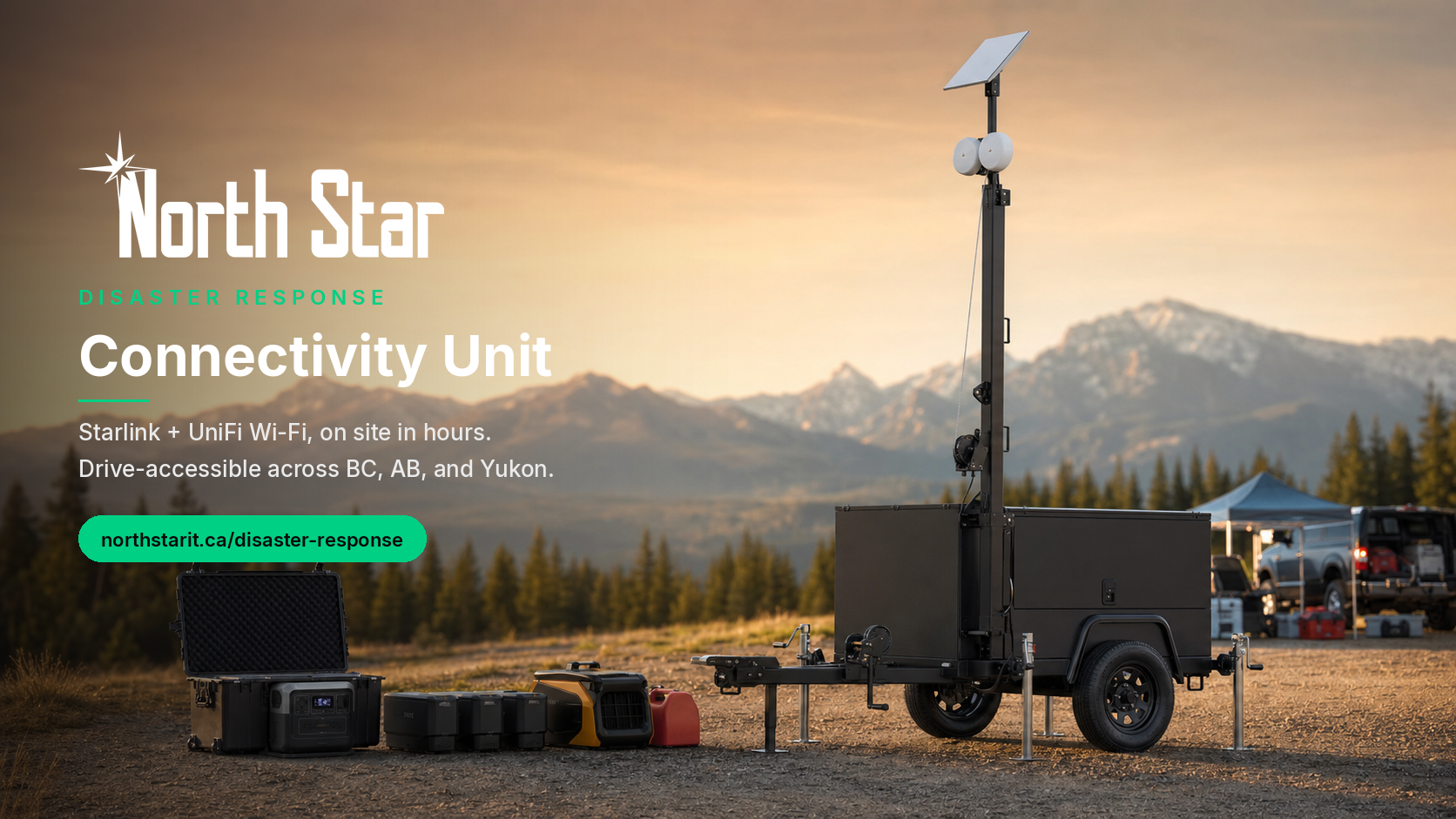
Starlink and UniFi Wi-Fi, on site in hours.
Wildfire base camp. Flood evacuation centre. Indigenous community cut off from cell service. We tow in a sealed kit, set the antenna, raise the mast, and your crews have Wi-Fi and a working internet link before the next briefing. Drive-accessible anywhere across BC, AB, and Yukon.
< 60 min
Setup time on arrival
150+ Mbps
Typical Starlink throughput
~29 hrs
Silent battery runtime
BC · AB · YT
Drive-accessible coverage
One trailer. One working network.
Every part is off-the-shelf and field-proven. No custom electronics, no single point of failure that takes days to replace. If something fails, the part is at any tier-one supplier in the country.
Starlink uplink
Starlink Mini on a rigid mast mount. Roam plan, unlimited data, low-Earth-orbit latency. Works the moment the antenna sees sky.
- LEO SATELLITE
- ROAM PLAN
- NO TERRESTRIAL
UniFi Wi-Fi
UCG-Ultra gateway, PoE switch, and two U7 outdoor access points. Covers a base camp, ESS, or small evac centre with proper enterprise Wi-Fi.
- WIFI 7
- OUTDOOR APs
- VLAN READY
EcoFlow power
Delta 3 Plus plus two expansion batteries. About 29 hours silent runtime on comms load. Smart Generator 3000 dual-fuel auto-starts when the bank gets low.
- BATTERY FIRST
- AUTO GEN START
- DUAL FUEL
Cold-weather cage
Insulated battery enclosure with a Stelpro heater and UniFi temperature sensor. Lithium stays inside its safe window down to minus thirty.
- INSULATED
- MONITORED
- −30 °C OK
Sealed transport
Two Pelican 1620 cases hold the gear when it's not deployed. Cabinet on the trailer locks. The whole thing rolls behind a half-ton.
- PELICAN 1620
- LOCKABLE
- HALF-TON TOW
Documented network
Every kit ships with a one-page SSID and password card, an incident SOP, and a phone number to call. No mystery configs.
- SSID CARD
- WRITTEN SOP
- SUPPORT LINE
Built for the people actually on site.
Pre-positioned during fire season. Activated when something happens. Returned when the incident closes.
Wildfire operations
Incident command bases, sustained-action camps, structure protection sectors. Anywhere a Type 1 or Type 2 IC team needs internet that doesn't depend on a single tower.
Flood and storm response
Evacuation centres, reception sites, ESS posts. Get the registration laptops online and the family-reunification line open without waiting for telco repair crews.
Indigenous communities
When a community is cut off by road closures, fire, or downed lines, a kit gets dropped on site so band administration, health, and emergency coordination keep working.
Local government
Regional district EOCs, municipal emergency operations, search-and-rescue staging. We pre-position the kit before fire season so activation is hours, not days.
Utilities and industry
Forestry, mining, energy, and contractor camps that move with the work. Drive in, set up, work, drive out.
Film and remote crews
Off-grid production units, research stations, and resource camps. Same kit, less dramatic mandate.
From phone call to working Wi-Fi.
Drive-only deployment model. We tow in, set up, and tear down. We do not maintain a 24-hour technician on site, the kit is built to run itself once it is configured.
Activation call
Incident commander, EOC director, or band administrator calls or emails. We confirm site address, drive route, expected duration, and number of users.
Dispatch from Prince George
Kit hooks up to the truck. We invoice the activation flat plus drive time. ETA gets shared the moment we leave the yard.
On-site deploy
Level the trailer, raise the mast, point Starlink, power up the network, confirm coverage with a walk-around. Hand over the SSID card.
Run remote
While deployed the kit runs unattended. We monitor uptime, generator state, and temperature from Prince George. Calls about the network come to us, not your team.
Tear-down and return
When the incident closes we drive back, pack the kit, and decommission the site. You get a usage report and the equipment goes back into the ready pool.
Pre-positioned and activated, priced separately.
You pay a monthly retainer to keep the kit ready and reserved. You pay activation rates when we actually deploy it. No surprise mid-incident invoices.
// RETAINER · DORMANT
Off-season standby
$950/month
Kit reserved for you. Bench tested monthly. Available on 24-hour notice. Charged year-round outside fire season.
// RETAINER · ACTIVE
Fire-season standby
$1,650/month
April through October. Kit cycled weekly, fuel topped, batteries conditioned. 12-hour dispatch.
// RETAINER · MULTI-KIT
Two kits reserved
$3,950/month
For regional districts and First Nations groups that need redundancy. Two kits, both maintained, both dispatchable.
// RETAINER · PRE-POSITIONED
Pre-staged at your site
$2,250/month
Kit lives on your yard or compound. We come out for monthly maintenance. Activation is instant. No drive time on dispatch.
Fire season starts soon.
Lock in a kit before April. We only run a small number of units and they get reserved early. Drop your district or band office details and we will scope and quote in 24 hours.